
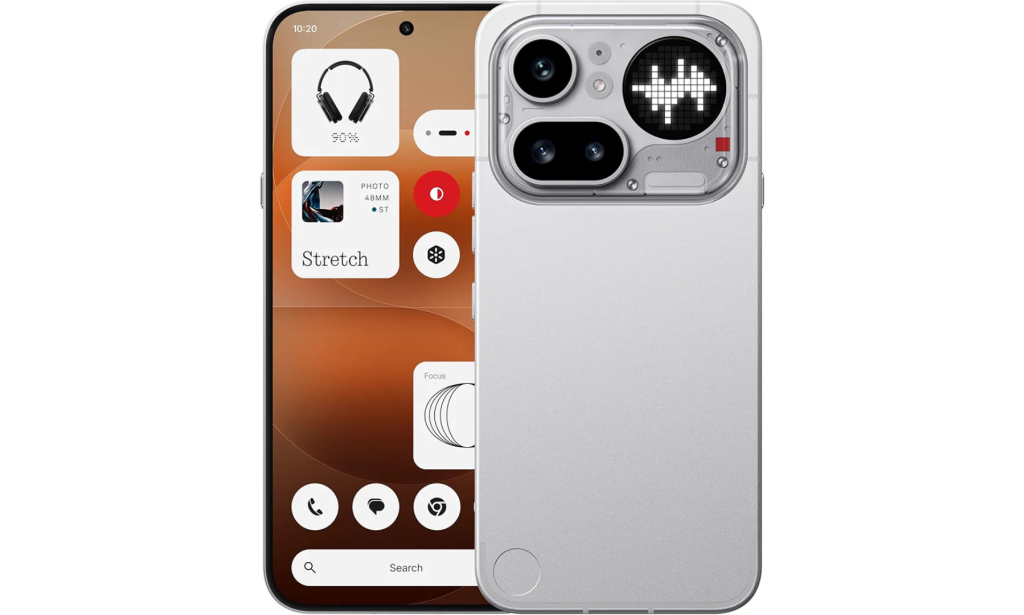
There is a quiet crisis happening in the smartphone world, and most people have not noticed it yet. The devices sitting at the top of the market Samsung's Galaxy S26 Ultra, Google's Pixel 10 Pro are technically more capable than ever before. But somewhere along the way, the industry's biggest players stopped trying to make phones that feel genuinely exciting to own. Small UK startup called Nothing, founded by OnePlus co-founder Carl Pei, is exposing exactly how bad the situation has become.
The Smartphone Market Has Become a Sea of Identical Black Rectangles
Walk into any phone store in 2026 and the options mostly look the same. Flat glass front, thin bezels, camera bump on the back, and a choice of a few neutral colors. Samsung and Google are both guilty of this, and the reason is straightforward: designing for the broadest possible audience means designing something that offends nobody which also means designing something that excites nobody.
The Galaxy S26 Ultra is a genuinely impressive piece of engineering. Its cameras, display, and processing power are class-leading. But pick one up and there is no sense of personality, no feeling that this device was made for you specifically rather than for the average of every possible customer. The same criticism applies to the Pixel 10 Pro. Better looking than some of its predecessors, technically solid, but unlikely to make you feel anything beyond mild satisfaction.
Even foldables, once the most adventurous category in Android, have settled into predictability. The Galaxy Z Fold 7 has reportedly pulled back on bold ideas like including the S Pen in pursuit of thinness. The result is a more refined device that is also a less interesting one.
Nothing Is Worth Over $1.3 Billion Because It Does Things Differently
Nothing is now valued at over $1.3 billion, and that number did not happen by accident. The company has built its entire identity around the idea that phones should have a point of view. The Nothing Phone 4a Pro, priced at $499, is a mid-range device that manages to feel more distinctive than most flagships costing twice as much.
The asymmetric camera layout and the Glyph Matrix display on the back will not be to everyone's taste and that is precisely the point. design that divides opinion is a design that someone genuinely loves. It sparks conversations. It reflects personality. It makes the person holding it feel like the phone was chosen rather than simply defaulted to. Nothing has understood something fundamental that Samsung and Google appear to have forgotten: people form emotional attachments to objects that feel personal, not to objects that feel average.
Not Every Feature Needs to Justify Its Existence With Productivity
Samsung and Google tend to approach every hardware decision through a practical lens. Features need to solve a problem or provide a measurable benefit. Samsung's moon photo processing, Google's Pixel thermometer both positioned as serious tools even if their real-world usefulness is limited for most people.
Nothing takes a different approach. The Glyph Matrix on the Phone 4a Pro does not do anything especially practical. It shows custom notification patterns and works as a mirror for rear-camera selfies. But it adds character to the device in a way that a spec sheet cannot measure. It makes people smile. That kind of emotional value is harder to quantify than camera resolution or processor benchmark scores, but it is arguably more important to daily satisfaction with a device.
This is not an argument for ignoring core fundamentals. phone still needs to take good photos, run apps smoothly, and last through the day on a charge. But Nothing has demonstrated that there is real value in letting designers pursue ideas that exist purely for delight rather than utility and that buyers will respond positively when they encounter those ideas.
Software Is Where Samsung Falls Shortest
Android was specifically designed to allow manufacturers to differentiate their products through software. The results in 2026 have been disappointing across the board. Samsung's One UI is functional and full of features, but its visual identity has become increasingly generic over the years. Motorola offers very little that stands out. Several Chinese manufacturers have essentially copied iPhone interface elements almost directly.
Nothing OS takes the opposite approach. Its monochromatic, retro-influenced design language is immediately recognizable and feels like a deliberate extension of the hardware it runs on. The interface is distinctive enough that users genuinely want to keep it rather than replace it with a third-party launcher or tone it down with a different theme. Even individual apps within Nothing OS including the companion app for Nothing's own earbuds carry the same visual consistency throughout.
The community around Nothing OS has also produced Glyph Toys and third-party apps that add new features while remaining visually faithful to the company's aesthetic. This kind of ecosystem engagement does not happen around software that feels generic.
What Samsung Could Learn From a $499 Mid-Range Phone
Nothing is not going to overtake Samsung in global sales volume. The resources, manufacturing scale, and retail reach simply do not compare. But Nothing has done something arguably more impressive: it has built a mid-range phone that generates genuine enthusiasm, loyalty, and word-of-mouth in a market segment where those qualities are almost entirely absent.
The Phone 4a Pro does have weaknesses. Camera quality is inconsistent at times. The 140x zoom is the kind of specification padding that adds nothing meaningful to real photography. The Essential Space AI feature is tied to a button that cannot be remapped, which limits its usefulness. Wireless charging is absent at a price point where it is starting to become expected.
But none of those shortcomings change the central point. Nothing has proven that it is possible to build a mid-range smartphone that people genuinely enjoy owning day to day not just because it performs well, but because it has a personality. Samsung, with its resources and engineering talent, could produce something extraordinary if it applied that same thinking to its flagship lineup. The Galaxy S27 Ultra with a design that actually makes people feel something would be a very different conversation than the one the industry is having right now.
The question is whether Samsung and Google are paying attention.

You must be logged in to post a comment.