
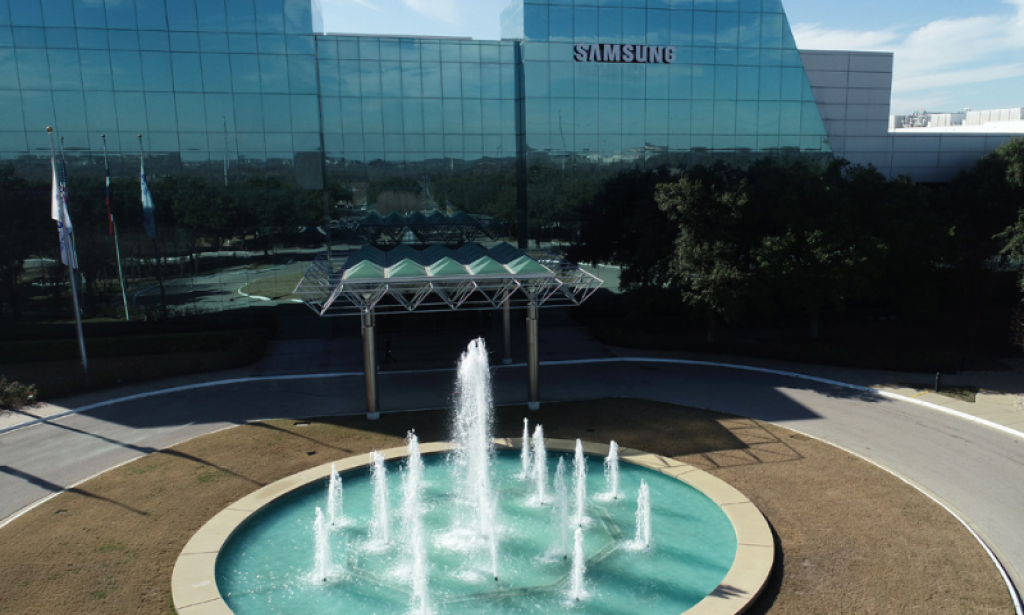
Samsung US Chip Factory in Taylor, Texas: Mass Production of 2nm Chips Starting 2027.
Samsung has officially confirmed that its massive advanced chipmaking facility in Taylor, Texas will begin mass production of chips for clients starting in 2027. The announcement was made on May 29, 2026 by Margaret Han, Vice President of Samsung's foundry division in the United States, during the Samsung Advanced Foundry Ecosystem Forum held at Samsung's US headquarters. Her words were direct and unambiguous: "We are ready. Customers will begin production at the Taylor fab starting next year."
This confirmation marks a critical milestone for Samsung's foundry business and for the broader US semiconductor industry. The Taylor factory has been years in the making, and its entry into mass production will position Samsung as a serious domestic chip manufacturing force in the United States for the first time.
WHAT IS THE SAMSUNG TAYLOR, TEXAS CHIP FACTORY?
The Samsung Taylor fab, officially known as the Samsung Semiconductor Advanced Manufacturing Facility, is a state-of-the-art advanced semiconductor fabrication plant located in Taylor, Texas, a city northeast of Austin. Samsung began construction on this facility in 2022 after announcing a $17 billion investment commitment, making it one of the largest foreign direct investments in American manufacturing history.
The factory was built to manufacture advanced logic chips using cutting-edge process nodes, primarily targeting the growing demand for AI chips, autonomous driving processors, and other high-performance semiconductor applications. It is part of Samsung's broader strategy to diversify its manufacturing footprint beyond South Korea and compete more aggressively with Taiwan's TSMC in the global foundry market.
Samsung's total investment in the Taylor facility is expected to exceed $17 billion when all phases of construction and equipment installation are complete, making it one of the most expensive semiconductor factories ever built on American soil.
TIMELINE: FROM ANNOUNCEMENT TO MASS PRODUCTION
Understanding how long this project has taken helps explain why the 2027 mass production confirmation is such a significant milestone.
2022: Samsung officially breaks ground on the Taylor, Texas facility and commits to the $17 billion investment. At the time, mass production was originally targeted for 2024.
2024 to 2025: The project faces delays related to construction timelines, equipment installation, and the broader challenges facing the global semiconductor industry including supply chain disruptions and a downturn in chip demand. Mass production targets are pushed back.
Early 2026: During Samsung's first quarter earnings call, the company describes the Taylor fab as still "under construction," with a stated goal of beginning operation within 2026.
May 29, 2026: At the Samsung Advanced Foundry Ecosystem Forum, Samsung VP Margaret Han publicly confirms the facility is ready and that customers will begin production at the Taylor fab in 2027, moving the formal mass production start into next year rather than late 2026.
2027: Mass production of advanced chips at the Taylor facility is set to begin for external foundry customers.
TESLA IS A CONFIRMED CUSTOMER
One of the most consequential details confirmed about the Samsung Taylor factory is the identity of at least one of its major customers: Tesla, one of the world's most valuable companies and the leader in electric vehicles and autonomous driving technology.
Tesla has a confirmed $16.5 billion deal with Samsung for the production of its next-generation self-driving chips, specifically the AI5 and AI6 autonomous driving processors. These chips are central to Tesla's Full Self-Driving technology and its long-term ambition to operate a fully autonomous robotaxi fleet.
The scale of Tesla's deal with Samsung is extraordinary. At $16.5 billion, it is one of the largest chip manufacturing contracts in the history of the semiconductor industry. It also underscores how critical advanced chip supply is becoming for the automotive industry as vehicles evolve from mechanical products into software-defined platforms powered by AI.
Tesla's AI5 and AI6 chips will be manufactured using Samsung's 2nm process technology at the Taylor facility. The 2nm process represents the current cutting edge of semiconductor manufacturing, offering significant improvements in power efficiency and raw performance compared to older 3nm and 4nm nodes. For self-driving applications where both peak computing power and energy efficiency are critical, 2nm chips provide meaningful real-world advantages.
WHAT IS 2NM CHIP MANUFACTURING AND WHY DOES IT MATTER?
For readers unfamiliar with semiconductor process nodes, here is a concise explanation of why 2nm manufacturing matters and what it means in practice.
In semiconductor manufacturing, the process node refers to the size of the transistors etched onto a chip. Smaller transistors mean more transistors can fit into the same physical space, which translates to higher performance and lower power consumption. A 2nm chip has transistors approximately two nanometers in size, which is roughly 50,000 times thinner than a human hair.
Chips manufactured on 2nm process nodes offer several important advantages over older manufacturing nodes:
Higher performance: More transistors per square millimeter means more computing power in the same chip footprint.
Better energy efficiency: Smaller transistors require less power to switch on and off, which means 2nm chips can deliver more performance per watt of energy consumed.
Stronger AI processing: AI workloads require massive parallel computation. Denser chip designs with more transistors handle AI tasks faster and more efficiently.
Competitive heat management: More efficient transistors generate less heat, which is particularly important for chips in data centers and vehicles where thermal management is a significant engineering challenge.
Currently, only Samsung and TSMC are capable of manufacturing chips at the 2nm node in production quantities. Intel is also targeting this capability but is still in the development phase. Samsung's ability to produce 2nm chips at scale in the United States is therefore a strategically important capability that very few companies in the world can match.
SAMSUNG'S NEXT-GENERATION 2NM ENHANCEMENT
Beyond the initial 2nm production already planned for the Taylor facility, Samsung has confirmed that it will begin building out a second-generation enhancement of its 2nm process in the near future at the same location.
This enhanced 2nm process, sometimes referred to internally as 2nm Gen 2 or an optimized SF2 process, has been specifically tuned for AI workloads. Samsung has indicated that this process improvement could deliver a performance improvement of up to 30 percent compared to the initial 2nm process for AI-intensive computing tasks.
A 30 percent performance improvement from a process enhancement alone, without changing the chip architecture, is a remarkable figure. For AI training, inference, and autonomous driving applications, this level of improvement can translate directly into faster decision-making, more capable AI models, and lower operating costs for data center operators.
This development pipeline means the Taylor facility is not just a one-time investment. It is designed to be a continuously improving platform that will remain at the frontier of chip manufacturing technology for years to come.
WHY IS SAMSUNG BUILDING CHIPS IN THE US?
The decision to invest $17 billion in a Texas chip factory was not made in isolation. Several powerful forces have been pushing Samsung, TSMC, Intel, and other chipmakers to expand manufacturing into the United States.
The CHIPS and Science Act: The US government passed the CHIPS Act in 2022, providing approximately $52 billion in subsidies and tax incentives for semiconductor companies that build manufacturing capacity in the United States. Samsung is eligible for significant CHIPS Act support for its Taylor investment, which reduces the effective cost of the project and improves its return on investment.
Supply chain security: The COVID-19 pandemic and subsequent global chip shortage of 2021 to 2023 exposed how dangerously concentrated semiconductor manufacturing had become in East Asia, particularly Taiwan. US government and corporate buyers are now placing significant value on having domestic chip manufacturing options that are not vulnerable to geopolitical disruption.
Tariff and trade policy: Trade tensions between the United States and China, as well as broader concerns about Taiwan's geopolitical situation, have accelerated the strategic push to build chip manufacturing capacity in politically stable countries with rule-of-law protections.
Customer proximity: Many of Samsung's largest potential foundry customers, including Tesla, Apple, Nvidia, AMD, and Qualcomm, are headquartered in the United States. Having manufacturing capacity in Texas reduces logistics complexity and allows for closer engineering collaboration between Samsung and its American clients.
SAMSUNG FOUNDRY VS TSMC: THE BIGGER PICTURE
The Taylor fab announcement comes at a critical moment in the ongoing competition between Samsung Foundry and TSMC for global chip manufacturing market share.
TSMC currently dominates the advanced foundry market with an estimated 60 percent or more of global revenue and is the manufacturing partner for Apple's iPhone chips, Nvidia's AI GPUs, AMD's processors, and many other high-profile products. TSMC is also building factories in Arizona with $65 billion in planned US investment.
Samsung Foundry has historically trailed TSMC in market share and yield rates, meaning Samsung has sometimes struggled to produce chips at the same consistency and quality as TSMC. However, Samsung has several advantages it is working to leverage. It has deeper vertical integration, manufacturing not just chips but also the DRAM and NAND flash memory that go into finished electronics. It has significant internal demand from its own Exynos chip division. And it has the $16.5 billion Tesla deal as a flagship customer win that demonstrates genuine confidence in Samsung's 2nm capabilities from a sophisticated buyer.
The Taylor facility's entry into mass production in 2027 will be a key test of Samsung's ability to close the gap with TSMC in advanced manufacturing quality and customer confidence.
IMPACT ON THE US SEMICONDUCTOR INDUSTRY
Samsung's Taylor factory is part of a broader reshaping of the global semiconductor supply chain that is unfolding in real time. Alongside Samsung's investment, TSMC is building advanced factories in Arizona, Intel is rebuilding its domestic manufacturing capabilities in Ohio and Arizona, and Micron is investing in memory chip production in Idaho.
The combined effect of these investments is a meaningful shift of advanced chip manufacturing capacity back to the United States after decades of offshoring. This has significant implications for US national security, economic competitiveness, and job creation. The Samsung Taylor facility alone is expected to create several thousand direct manufacturing jobs and tens of thousands of indirect jobs in the regional supply chain.
For the AI industry specifically, having advanced 2nm chip manufacturing capacity on US soil means that American AI companies developing next-generation models and autonomous systems will have access to cutting-edge chips manufactured domestically, reducing dependence on overseas supply chains for strategically critical technology.
WHAT THIS MEANS FOR SAMSUNG'S BUSINESS
For Samsung itself, the Taylor factory's entry into production represents a significant strategic pivot. Samsung has historically been primarily known as a consumer electronics and memory chip company. Its foundry business, which manufactures chips for external customers, has been a growing but secondary priority.
The $17 billion Texas investment and the $16.5 billion Tesla deal together signal that Samsung is making a serious long-term bet on foundry manufacturing as a core business pillar alongside its consumer electronics and memory operations. If the Taylor facility achieves the yield rates and quality consistency needed to retain and expand its customer base, it could fundamentally change Samsung's position in the global chip industry.
The 2nm process enhancement tuned for AI workloads is also strategically significant. AI chip demand is growing at a rate that most analysts believe will continue for at least the next decade. By positioning the Taylor facility as an AI-optimized manufacturing center from the outset, Samsung is aiming to capture a share of what is likely to be the most valuable segment of the chip market for the foreseeable future.
When will Samsung's Texas chip factory start mass production?
Samsung has confirmed that mass production of advanced chips at its Taylor, Texas facility will begin in 2027. The confirmation was made on May 29, 2026 by Samsung VP Margaret Han at the Samsung Advanced Foundry Ecosystem Forum.
How much has Samsung invested in the Taylor, Texas factory?
Samsung's total investment in the Taylor fab is expected to exceed $17 billion, making it one of the largest foreign direct investments in American manufacturing history.
What chips will be made at Samsung's Texas factory?
The Taylor facility will produce advanced 2nm chips for external foundry customers. Confirmed chips include Tesla's AI5 and AI6 autonomous driving processors, which are part of a $16.5 billion manufacturing deal between Tesla and Samsung.
What is Samsung's 2nm chip process?
Samsung's 2nm process, known as SF2, is one of the most advanced semiconductor manufacturing nodes available in the world. It enables higher performance, better energy efficiency, and stronger AI processing capabilities compared to older 3nm and 4nm processes.
Why is Samsung building chips in the United States?
Samsung is manufacturing chips in the US due to CHIPS Act government incentives, growing demand for domestic chip supply chains, trade policy pressures, and the proximity of major US-based customers like Tesla, Apple, and Nvidia.
What is the second-generation 2nm process Samsung is developing?
Samsung is developing an enhanced version of its 2nm process specifically optimized for AI workloads. This next-generation process is expected to deliver up to 30 percent better performance for AI-intensive computing tasks compared to the initial 2nm process.
How does Samsung's Texas factory compare to TSMC's US factories?
Both Samsung and TSMC are building advanced chip factories in the United States. TSMC is investing $65 billion in Arizona facilities. Samsung's Taylor investment exceeds $17 billion. TSMC currently leads the foundry market in market share, but Samsung's 2nm capabilities and the Tesla deal demonstrate it is a serious competitor.
Samsung's confirmation that its Taylor, Texas chip factory will begin mass production in 2027 is a landmark moment for the US semiconductor industry, for Samsung's foundry business, and for the global chip manufacturing landscape. After years of construction, delays, and uncertainty, the facility is now ready to deliver advanced 2nm chips to customers including Tesla, with a performance-enhanced AI-optimized process already in development.
The combination of a $17 billion facility investment, a $16.5 billion Tesla deal, and next-generation 2nm process development positions the Taylor factory as one of the most strategically significant semiconductor manufacturing sites in the United States. As AI demand continues to accelerate and the push for domestic chip supply chains intensifies, Samsung's Texas bet is looking increasingly well-timed.
What do you think about Samsung's US chip manufacturing expansion? Share your thoughts in the comments below.

You must be logged in to post a comment.