
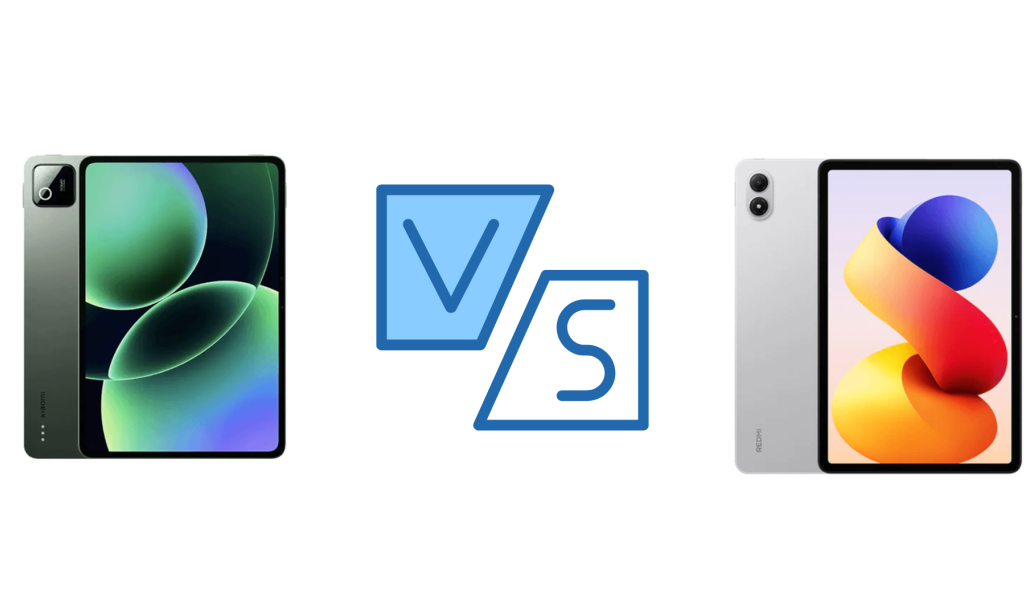
Xiaomi currently makes two tablets that sit very close to each other in price but are built around completely different philosophies. The Xiaomi Pad 8 Pro is a compact, performance-focused powerhouse with a flagship chipset in a thin and light body. The Redmi Pad 2 Pro is a large-screen, battery-first tablet designed for people who want a big display and days of endurance without spending a fortune. If you are trying to decide between the two, the choice comes down to what matters most to you and this comparison will make that decision straightforward.
Design and Build: Compact Premium vs Large and Practical
The Xiaomi Pad 8 Pro measures 251.22 x 173.44 x 5.75mm and weighs just 485 grams. That 5.75mm thickness makes it one of the slimmest tablets in its class, and the all-aluminium chassis gives it a premium feel that genuinely rivals more expensive competitors. It is the kind of tablet you pick up and immediately think was built with care.
The Redmi Pad 2 Pro is a significantly larger device at 279.80 x 181.65 x 7.5mm and 610 grams. The extra size is not a mistake it exists to accommodate the 12.1-inch display and the massive 12,000mAh battery inside. The build is solid aluminium with Corning Gorilla Glass 3 on the front, which is a step down from the Pad 8 Pro but still respectable at this price. If you are planning to use this tablet at a desk, on a flight, or propped up for content consumption, the size is a feature rather than a limitation. If you want something to carry comfortably in a bag or hold in one hand for extended reading, the Pad 8 Pro's compact body is noticeably more practical.
Display: Smaller and Sharper vs Larger and More Cinematic
The Xiaomi Pad 8 Pro has an 11.2-inch IPS LCD panel with a 3.2K resolution of 3200 x 2136 pixels at a 3:2 aspect ratio. The refresh rate is adaptive up to 144Hz, and the pixel density reaches 344 PPI one of the sharpest tablet displays available at any price in 2026. It supports Dolby Vision, HDR10, 12-bit colour depth, wet touch technology, and carries TÜV Rheinland certifications for low blue light, flicker-free performance, and circadian rhythm protection. Peak brightness reaches 800 nits in HBM mode.
The Redmi Pad 2 Pro has a 12.1-inch IPS LCD panel with a 2.5K resolution of 2560 x 1600 pixels at a 16:10 aspect ratio, delivering a pixel density of 249 PPI. The refresh rate reaches up to 120Hz with a 360Hz touch sampling rate. It supports Dolby Vision, 1.07 billion colours, and carries the same TÜV Rheinland certifications as the Pad 8 Pro. Brightness peaks at 600 nits in HBM mode, with a typical brightness of 500 nits.
In terms of raw sharpness, the Pad 8 Pro wins clearly at 344 PPI versus 249 PPI. The difference is visible when reading text or viewing detailed images up close. However, the Redmi Pad 2 Pro's larger 12.1-inch screen gives it a genuine advantage for movie watching, productivity with multiple windows open simultaneously, and anything that benefits from physical screen real estate. Both displays are solid the Pad 8 Pro is sharper, the Redmi Pad 2 Pro is bigger.
Chipset and Performance Flagship Power vs Capable Mid-Range
This is where the two tablets are furthest apart. The Xiaomi Pad 8 Pro runs on Qualcomm's Snapdragon 8 Elite the same chipset found in the Galaxy S26 Ultra and other top-tier flagship phones. Built on a 3nm process with Qualcomm's Oryon V2 CPU cores running at up to 4.32GHz and the Adreno 830 GPU, this is currently one of the two or three most powerful mobile chipsets in existence. It is paired with LPDDR5X RAM and UFS 4.1 storage in most configurations. Geekbench 6 single-core scores land around 2,946 and multi-core around 8,834.
The Redmi Pad 2 Pro uses the Qualcomm Snapdragon 7s Gen 4, built on a 4nm process with Adreno 810 GPU and LPDDR4X RAM with UFS 2.2 storage. This is a capable upper mid-range chipset that handles everyday tasks, streaming, light gaming, and productivity without any issues. But it is not in the same performance tier as the Snapdragon 8 Elite. The AnTuTu score on the Redmi Pad 2 Pro lands around 880,000, compared to well over 2.5 million on the Pad 8 Pro. For demanding gaming, heavy multitasking, video editing, or any AI-heavy workloads, the Pad 8 Pro is significantly faster. For watching YouTube, browsing, note-taking, and light gaming, the Redmi Pad 2 Pro handles everything smoothly.
Camera: Neither Is a Priority, But the Pad 8 Pro Leads
The Xiaomi Pad 8 Pro features a 50MP rear camera with f/1.8 aperture using a Samsung S5KJN1 sensor, capable of 4K video recording, paired with a 32MP front camera using an Omnivision OV32D sensor at f/2.2. These are genuinely capable cameras for a tablet the 50MP main sensor produces detailed images and the 32MP front camera delivers excellent video call quality.
The Redmi Pad 2 Pro is more modest with an 8MP rear camera and an 8MP front camera. Both deliver acceptable quality for video calls and document scanning but are not designed for serious photography or video production. If camera quality matters at all for your tablet use, the Pad 8 Pro leads by a meaningful margin.
Battery: and Charging The Redmi Pad 2 Pro's Biggest Advantage
The Redmi Pad 2 Pro carries a 12,000mAh battery the largest battery in any 12.1-inch tablet according to Xiaomi, and one of the largest in any Android tablet currently available. Real-world endurance figures suggest two to three days of moderate use between charges, making it genuinely exceptional for travel, field work, or users who want to go extended periods without thinking about power. The trade-off is that charging is only 33W, meaning a full charge from empty takes approximately two and a half hours. The tablet also supports 27W reverse wired charging, so it can charge your phone, earbuds, or smartwatch directly from the tablet.
The Xiaomi Pad 8 Pro carries a 9,200mAh battery with 67W HyperCharge wired charging. PhoneArena's battery test records a battery life estimate of 7 hours 22 minutes, which is solid for a Snapdragon 8 Elite-powered device but falls noticeably short of the Redmi Pad 2 Pro's endurance. The 67W charging speed is significantly faster filling the 9,200mAh battery considerably quicker than the Redmi Pad 2 Pro's 33W system.
For users who prioritise endurance above all else, the Redmi Pad 2 Pro is the clear winner. For users who want faster top-ups and acceptable all-day battery, the Pad 8 Pro is fine.
Audio: Both Are Excellent, Pad 8 Pro Has Six Speakers
The Xiaomi Pad 8 Pro features a six speaker setup with Dolby Atmos support an unusually generous configuration for a tablet at any price. Audio quality is genuinely impressive for portable device use, with good separation and clarity at volume. The Redmi Pad 2 Pro has four speakers with Dolby Atmos and Hi-Res Audio support. Both tablets deliver better audio than most devices in their class, but the Pad 8 Pro's six-speaker system edges ahead for media consumption.
Connectivity: Redmi Pad 2 Pro Has More Ports and a Headphone Jack
The Pad 8 Pro supports Wi-Fi 7, Bluetooth 5.4, NFC, and USB-C 3.2 Gen 1. There is no 3.5mm headphone jack and no microSD card slot. The Redmi Pad 2 Pro supports Wi-Fi 6, Bluetooth 5.3, and USB-C, and critically includes both a 3.5mm headphone jack and a microSD card slot for expandable storage two features the Pad 8 Pro does not offer. If you use wired headphones or want to expand your storage cheaply without buying a higher configuration, the Redmi Pad 2 Pro wins this category.
Storage: and RAM Options
The Xiaomi Pad 8 Pro is available in 8GB/128GB, 8GB/256GB, 8GB/512GB, 12GB/256GB, and 12GB/512GB configurations, with higher configurations using faster UFS 4.1 storage. The Redmi Pad 2 Pro comes in 6GB/128GB and 8GB/256GB options with UFS 2.2 storage, plus a microSD card slot for expanding storage externally.
Price: The Gap Is Significant
The Xiaomi Pad 8 Pro starts at €449.99 for the 8GB/128GB configuration in Europe, with the 8GB/256GB at €499.99 and the 12GB/512GB at €679.99. In the US market it is priced from approximately $530.
The Redmi Pad 2 Pro starts at $279.99 for the 6GB/128GB configuration and $299 for the 8GB/256GB variant in the US. That makes the base Redmi Pad 2 Pro roughly $230 cheaper than the base Pad 8 Pro a substantial gap.
Which One Should You Buy?
Buy the Xiaomi Pad 8 Pro if you want the sharpest display available on a mid-range tablet, flagship-level performance for gaming and demanding apps, a premium thin and light build that is easy to carry, superior cameras for video calls and content creation, Wi-Fi 7 connectivity, and a six-speaker audio system. It is the better choice for power users, gamers, and anyone who wants the most capable tablet Xiaomi makes outside of the flagship Xiaomi Pad 9 tier.
Buy the Redmi Pad 2 Pro if you want a larger 12.1-inch screen for movies, productivity, and reading, exceptional battery life that can genuinely last two to three days, a significantly lower price that leaves budget for accessories, a 3.5mm headphone jack and microSD card expansion, and a tablet that handles everyday tasks without any performance concerns. It is the better choice for students, frequent travellers, casual users, and anyone who prioritises endurance and screen size over raw performance.

You must be logged in to post a comment.