
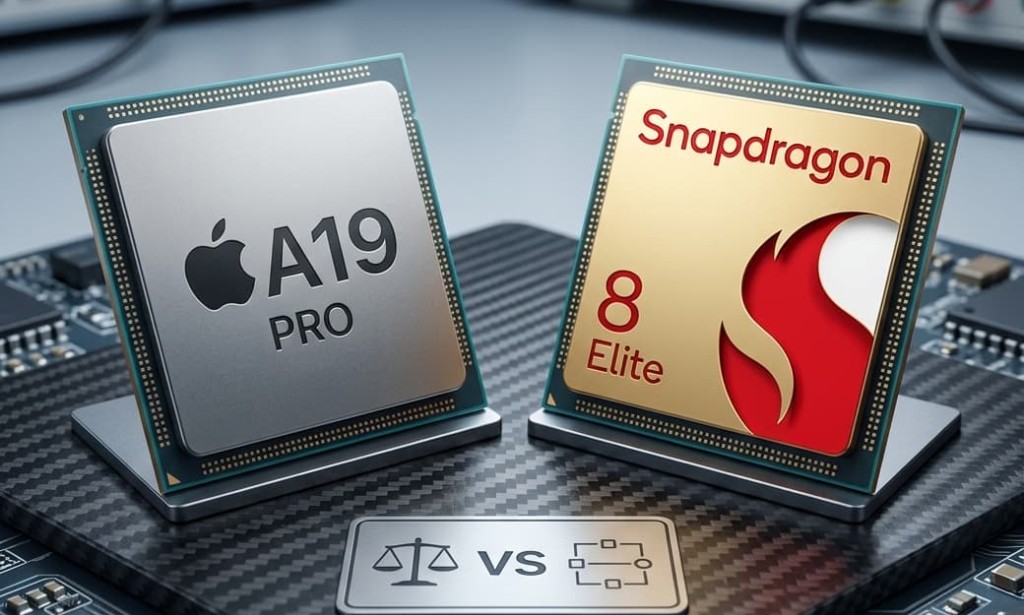
Every year the same battle plays out between Apple and Qualcomm, and every year it gets closer. With the iPhone 17 Pro series running the A19 Pro and Android flagships like the Galaxy S26 powered by the Snapdragon 8 Elite Gen 5, this is the most competitive that comparison has ever been. Here is what the benchmark numbers actually show and what they genuinely mean for day-to-day use.
The Chips at a Glance
Before getting into the numbers, it helps to understand what each chip is working with. The Apple A19 Pro uses a 6-core CPU configuration with two high-performance cores running at up to 4.26GHz and four efficiency cores, manufactured on TSMC's 3nm process. The Snapdragon 8 Elite Gen 5 uses an 8-core layout with Qualcomm's third-generation Oryon V2 CPU cores two prime cores at 4.61GHz and six performance cores also built on TSMC's 3nm process. The A19 Pro integrates Apple's own GPU. The Snapdragon 8 Elite Gen 5 uses the Adreno 840.
The core count difference matters when interpreting multi-core results. More cores means more parallel processing capacity, which naturally advantages the Snapdragon in multi-threaded benchmarks regardless of architectural efficiency.
Geekbench 6 CPU Performance
The A19 Pro on the iPhone 17 Pro Max scores approximately 3,895 in Geekbench 6 single-core and 9,746 in multi-core. The Snapdragon 8 Elite Gen 5 on Qualcomm's reference device scored approximately 3,920 in single-core and 12,208 in multi-core.
The single-core result is the headline number. For the first time in the history of this rivalry, Qualcomm has essentially matched Apple in single-core CPU performance. The gap is marginal roughly 0.6% in favor of the Snapdragon and within the margin of test variance. In practical terms, these two chips are equal in single-core CPU performance.
The multi-core gap is more meaningful. The Snapdragon 8 Elite Gen 5 scores approximately 22% higher than the A19 Pro in Geekbench multi-core. Given that the Snapdragon has eight cores versus Apple's six, this advantage is partly structural you cannot ignore the core count when discussing parallel performance. Apple achieving 9,746 multi-core with six cores compared to Qualcomm's 12,208 with eight cores means Apple is getting significantly more output per core than Qualcomm.
What this means in practice: for tasks that run on a single thread opening an app, processing a single photo, rendering a single UI animation both chips are now essentially equal. For tasks that use multiple threads simultaneously exporting a video, running AI inference across multiple models, handling large downloads while gaming the Snapdragon leads.
AnTuTu: The Platform Comparison Problem
Qualcomm's reference device scores between 4.25 and 4.5 million on AnTuTu. The iPhone 17 Pro Max scores significantly lower on the iOS version of the same benchmark. This is where a critical caveat applies: AnTuTu results from iOS and Android are not directly comparable. The benchmark runs on different APIs, different operating systems, and different memory architectures. A raw number comparison between Apple's AnTuTu score and Qualcomm's AnTuTu score tells you very little about real-world performance differences between the two platforms. The gap in AnTuTu totals reflects platform differences as much as chip performance.
GPU Performance Apple Caught Up, Qualcomm Pushed Further
The GPU story has been the most dramatic shift over the past two years. The Snapdragon 8 Elite from 2024 held a meaningful GPU advantage over the A18 Pro. Apple closed most of that gap with the A19 Pro, which performed strongly enough in GPU benchmarks to match or beat some Android flagships in specific tests. Qualcomm then pushed further with the Adreno 840 in the Snapdragon 8 Elite Gen 5.
In cross-platform GPU benchmarks that use Vulkan on Android and Metal on iOS like 3DMark Wildlife the Snapdragon 8 Elite Gen 5 posts higher absolute scores. However, GPU benchmarks are one of the most platform-dependent measurements in mobile testing. The underlying graphics APIs are different, the way each platform handles memory is different, and real gaming performance depends as much on the game engine's optimization for a specific platform as it does on the raw GPU throughput. A game built and optimized for iPhone will run differently than the same engine running on Android regardless of what the benchmarks say.
What the numbers show clearly is that both GPUs are in the same tier of performance for the tasks most users care about gaming, image processing, and video rendering with the Snapdragon claiming the edge in sustained peak output and the A19 Pro delivering better efficiency and consistency.
Thermal Performance and Sustained Performance
This is an area where Apple's chip design philosophy continues to demonstrate a structural advantage. The A19 Pro maintains its performance numbers more consistently under sustained load the gap between peak and sustained performance is smaller on iPhone than on most Android devices. Qualcomm has made significant progress in reducing throttling with the Snapdragon 8 Elite Gen 5 compared to previous generations, but Apple's long-standing advantage in sustained thermal performance has not been fully closed.
In shorter benchmark bursts, the Snapdragon 8 Elite Gen 5 reaches a higher performance ceiling. In extended real-world tasks long gaming sessions, exporting a large video file, running background AI processing the A19 Pro delivers more predictable and consistent output because it throttles less aggressively.
Energy Efficiency Apple Still Has the Edge
Despite having a lower peak clock speed than the Snapdragon 8 Elite Gen 5, the A19 Pro achieves comparable single-core performance, which means Apple is extracting more work per gigahertz a measure of architectural efficiency. This translates to better performance-per-watt, which in turn contributes to iPhone's consistently strong battery life despite using physically smaller batteries than most competing Android flagships.
The Snapdragon 8 Elite Gen 5 is Qualcomm's most efficient chip to date, promising 16% better power savings compared to its predecessor. But Apple's lead in performance-per-watt remains measurable and real.
Which Chip Is Actually Better
This question only makes sense within a specific context.
For single-threaded tasks which represent the majority of what most people do on a phone these two chips are now equivalent. That is genuinely significant. Qualcomm has never been this close to Apple in this metric before.
For multi-threaded workloads video production, large AI models, heavy multitasking the Snapdragon 8 Elite Gen 5 leads thanks to its two additional CPU cores and higher peak GPU output.
For sustained, long-duration performance extended gaming, and large file processing the A19 Pro is more consistent and throttles less.
For energy efficiency, the A19 Pro still extracts more performance per watt, which benefits battery life across every usage scenario.
The platform question matters more than the chip question for most buyers. Someone choosing between an iPhone and a Galaxy S26 is not really choosing between two chips they are choosing between iOS and Android, between the App Store and Google Play, between Apple's ecosystem and Samsung's. Either chip will handle anything a phone needs to do in daily life without any perceptible limitation. The benchmark gap between them is meaningful for engineers but largely invisible to users who are scrolling Instagram, taking photos, or watching video.

You must be logged in to post a comment.