
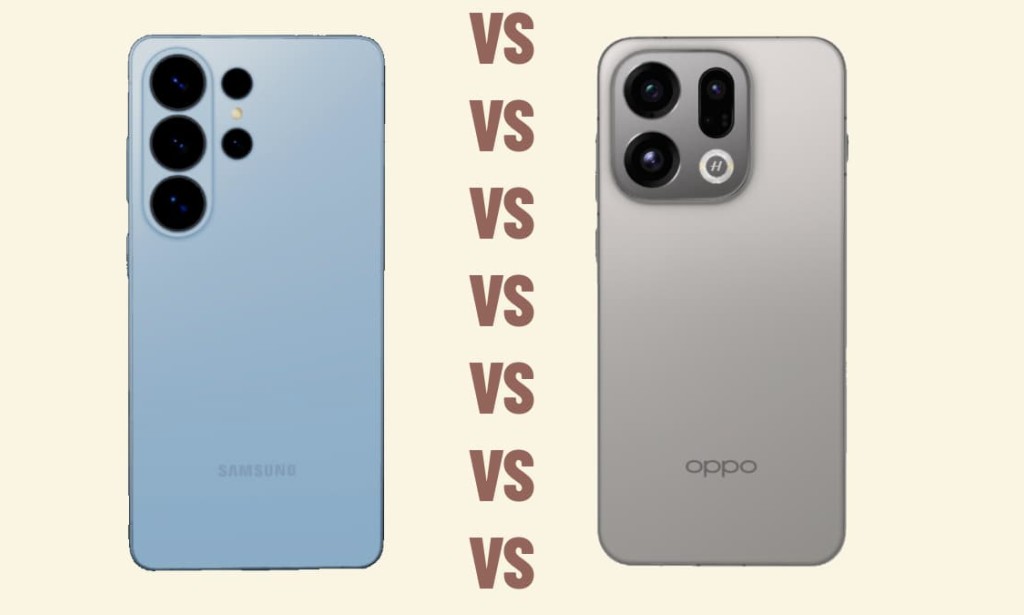
Two phones Two very different philosophies. One very difficult decision.
The Samsung Galaxy S26 120Hz onnnnnnas held the top spot in Android for years, and for good performance, polished, capable, and backed by one of the most reliable software ecosystems in the business. But this year, OPPO has stepped up in a way that cannot be dismissed. The Find X9 Ultra is not just a strong competitor it is, in several me120Hz onnnnnne ways, the more aggressive phone. It has a bigger battery, a bolder camera system, and faster charging than anything Samsung currently offers at this price point.
So which one do you actually buy?
That depends on what you value. This comparison will break it all down display, performance, cameras, battery, software, and price with real numbers and pitch. Let's get into it.
Quick Specs Overview
| Feature | OPPO Find X9 Ultra | Samsung Galaxy S26 Ultra |
| Display | 6.82" LTPO AMOLED 2K, 120Hz | 6.9" Dynamic AMOLED 2X, 120Hz on |
| Chipset | Snapdragon 8 Elite Gen 5 | Snapdragon 8 Elite Gen 5 (Custom) |
| RAM | 16GB | 12GB / 16GB |
| Storage | 512GB / 1TB | 256GB / 512GB / 1TB |
| Main Ca | 200MP f/1.5, SallowsYT-901 | 200MP to.4 |
| Telephoto | 200MP 3x + 50MP 10x (dual periscope) | 50MP 3x + 50MP 5x |
| Ultra-wide | 50MP f/2.0 | 50MP f/1.9 |
| imon proves | MP | |
| Battery | 7,050mAh Si/C | 5,000mAh |
| Wired Charging | 100W SUPERVOOC | 60W Super Fast Charging 3.0 |
| Wireless Charging | 50W AIRVOOC | 25W |
| OS | ColorOS 16 (Android 16) | One UI 8.5 (Android 16) |
| S Pen | No | Yes |
| IP Rating | IP68 | IP68 |
| Starting Price | ~$1,099 | $1,299 |
Design and Build Quality
Both phones are built to premium flagship standards, but they feel different in the hand and make different design statements.
The Galaxy S26 Ultra is a refinement of a formula Samsung has been perfecting for years. It measures 163.6 x 78.1 x 7.9mm and weighs 214 grams. The frame is constructed from Armor Aluminum, the back uses Corning Gorilla Glass Armor 2, and the overall result is a device that feels exceptionally solid and durable. It is thin for an Ultra-tier phone, and the flat display edges give it a clean, professional look that works equally well in a boardroom or on a hiking trail. The S Pen slots in at the bottom, as always, and its presence shapes the entire form factor.
The OPPO Find X9 Ultra takes a bolder visual approach. The large, circular Hasselblad camera module on the rear is its most distinguishing feature signaling what this phone is about before you even turn it on. OPPO offers the Find X9 Ultra in a vegan leather option alongside glass variants, and the leather finish provides noticeably better grip and a more distinctive look than what most competitors offer. At 6.82 inches and 8.65mm thick, it is slightly more compact than the S26 Ultra, though the camera bump adds to the overall depth in hand.
Both phones carry IP68 dust and water resistance, so neither has an edge on durability in that regard.
Winner: Tie. Samsung offers a slimmer, more understated build with S Pen integration. OPPO offers more character and better grip options. This one genuinely comes down to personal preference.
Display
The S26 Ultra uses a 6.9-inch Dynamic AMOLED 2X panel with 1440p resolution, 120Hz refresh rate, HDR10+ support, and a peak brightness of 2,600 nits. It also introduces a world-first feature this year: a built-in Privacy Display. Unlike privacy films sold as accessories, this panel can narrow its own viewing angle on demand at the hardware level, so bystanders cannot see your screen without the user experiencing any compromise in clarity. It is a genuinely useful feature for anyone who travels frequently or works in public spaces.
The Find X9 Ultra uses a 6.82-inch LTPO AMOLED 2K panel with a 3216 x 1440 resolution, 120Hz refresh rate, and a 5,000,000:1 contrast ratio. LTPO technology allows the display to dynamically scale its refresh rate between 1Hz and 120Hz depending on the content on screen, which improves power efficiency during normal use.
Both displays are excellent. The S26 Ultra's Privacy Display is a meaningful differentiator that has no equivalent on the Find X9 Ultra. Samsung's panel tuning is also slightly more mature in terms of color accuracy and outdoor readability, having been refined over multiple generations.
Winner: Samsung Galaxy S26 Ultra, primarily due to the Privacy Display feature and display tuning refinement.
Performance
Both phones are powered by the Snapdragon 8 Elite Gen 5, which is currently the most powerful mobile chip available on Android. However, Samsung uses a custom-tuned variant, the SM8850-AC, which is optimized specifically for the S26 Ultra's thermal and performance profile.
In Geekbench multi-core testing, the Galaxy S26 Ultra scores approximately 11,407 compared to the Find X9 Ultra's 10,574. The difference is not dramatic in real-world use both phones handle gaming, multitasking, video editing, and every intensive workload without hesitation. Samsung's chip advantage becomes slightly more noticeable under sustained heavy loads, where its thermal management has also improved through an upgraded vapor chamber. OPPO's thermal performance is solid as well, particularly during extended camera use, but Samsung edges ahead on raw sustained performance.
For everyday users, neither phone will ever feel slow. The performance gap is a benchmark distinction, not a practical one.
Winner: Samsung Galaxy S26 Ultra, by a narrow margin in sustained performance.
Camera System
This is the section that will define the buying decision for most people, and it is where the two phones diverge most sharply in their approaches.
Samsung Galaxy S26 Ultra Camera
Samsung runs a quad-camera system. The main sensor is a 200MP unit with a new f/1.4 aperture a wider opening than the S25 Ultra's f/1.7, which improves low-light performance meaningfully. The telephoto system includes a 3x and a 5x periscope lens, both at 50MP. There is a 50MP ultra-wide rounding out the setup. Samsung's image processing is extremely well-tuned. Colors are natural, dynamic range is handled well, and the AI-assisted zoom produces respectable results up to 5x. Beyond that, digital zoom quality degrades faster than OPPO's hardware setup allows.
OPPO Find X9 Ultra Camera
OPPO has built what is, on paper, the most extreme camera system on any flagship slab in 2026. The setup includes five cameras. The main sensor is a 200MP f/1.5 unit using the Sony LYT-901 at a 1/1.12-inch sensor size — making it one of the largest sensors in any smartphone currently available. The ultra-wide is a 50MP f/2.0 lens. Then come two periscope telephoto cameras: a 200MP 3x unit using OmniVision's OV52A sensor at 1/1.28 inches, and a 50MP 10x ultra-telephoto. There is also a 3.2MP monochrome sensor. All of this is developed in partnership with Hasselblad under OPPO's New-Generation Hasselblad Master Camera System, which brings Hasselblad color science, natural tones, and professional shooting modes including XPAN format support.
The practical result is that the Find X9 Ultra has a genuine hardware advantage at range. The 10x optical zoom delivers quality that the S26 Ultra's 5x system simply cannot match at equivalent distances. The dual 200MP telephoto setup is exceptional for portrait and telephoto work. The main sensor's larger size and f/1.5 aperture also perform strongly in low light.
Samsung retains an edge in processing consistency and AI features. Galaxy AI, including Circle to Search, Gemini integration, and photo editing tools, is more mature and better integrated into the overall software experience than OPPO's AI toolkit. For casual photographers who want reliable, excellent photos every single time, Samsung remains very competitive. For enthusiasts who want optical reach and the maximum hardware ceiling, OPPO is ahead.
Winner: OPPO Find X9 Ultra for camera hardware versatility and telephoto range. Samsung Galaxy S26 Ultra for processing consistency and AI integration.
Battery Life and Charging
This is the least contested category in the entire comparison.
The Find X9 Ultra ships with a 7,050mAh silicon-carbon battery the largest capacity in any ultra-flagship slab form factor currently available. The S26 Ultra carries a 5,000mAh cell. That is a 40 percent capacity advantage in OPPO's favor, and it translates directly to real-world endurance. In screen-on time testing, the Find X9 Ultra averages approximately 17 hours compared to the S26 Ultra's 14 hours and 26 minutes. On heavy camera days, travel days, or long workdays away from a charger, the gap is noticeable.
Charging speed compounds the advantage further. OPPO supports 100W SUPERVOOC wired charging and 50W AIRVOOC wireless charging. Samsung has improved this year to 60W Super Fast Charging 3.0 wired and 25W wireless both upgrades over the previous generation, but still meaningfully slower than what OPPO offers.
The S26 Ultra's battery life is not bad. It handles a full day of standard use comfortably. But the Find X9 Ultra is simply in a different category when it comes to endurance and charging.
Winner: OPPO Find X9 Ultra, clearly and convincingly.
Software and Ecosystem
Samsung's One UI 8.5 is one of the most refined Android experiences available. It is packed with features, Samsung DeX turns the phone into a desktop computing environment, and Galaxy AI brings genuinely useful tools including Gemini integration, Circle to Search, live translation, and AI-powered photo and document editing. Samsung also commits to seven years of OS and security updates, which is a meaningful long-term value proposition.
OPPO's ColorOS 16 is clean, smooth, and highly customizable. For users within the OPPO or OnePlus ecosystem, it integrates well. However, it does not match Samsung's global app and service ecosystem depth, and OPPO's software update commitment currently trails Samsung's seven-year pledge.
If you rely on a broader ecosystem of Samsung tablets, Galaxy Watch, Samsung PC link features, or DeX the S26 Ultra makes far more sense as a devicely driver. If software longevity is and ecosystem integration are less of a priority, ColorOS 16 is a capable and pleasant platform.
Winner: Samsung Galaxy S26 Ultra for software depth, ecosystem integration, and update longevity.
Price and Value
The Samsung Galaxy S26 Ultra starts at $1,299 for the 256GB model in the US. The 512GB configuration pushes to $1,499, and the 1TB version reaches $1,799.
The OPPO Find X9 Ultra is priced more aggressively, starting at approximately $1,099 for the 512GB configuration globally giving buyers significantly more base storage for roughly $200 less than the equivalent Samsung option.
From a pure hardware-per-dollar standpoint, the Find X9 Ultra offers more at a lower price. Samsung's premium is justified partly by brand recognition and partly by the broader ecosystem and software update guarantee factors that help provide real value depending on the buyer.
Winner: OPPO Find X9 Ultra for hardware value. Samsung Galaxy S26 Ultra justifies its price through software longevity and ecosystem.
Who Should Buy Which Phone?
Buy the OPPO Find X9 Ultra if:
- Camera versatility and optical zoom range are your top priority
- Battery life and charging speed matter to you
- You want more hardware for a lower price
- You prefer a more distinctive, camera-forward design
Buy the Samsung Galaxy S26 Ultra if:
- You need the S Pen for productivity or note-taking
- You are invested in the Samsung ecosystememememememem (DeX, Galaxy Watch, tablets)
- Long-term software support is important to you
- You value the Privacy Display feature
- You want a more refined, established software experience
Final Verdict
There is no clean winner here, and that is actually the most honest thing that can be said about this comparison. Both phones are outstanding, and the right choice depends entirely on what you use a smartphone for.
The OPPO Find X9 Ultra is the better camera hardware device. It has a bigger battery, faster charging, more optical reach, and costs less. If you want the best camera you can buy in a smartphone right now, this is the one to get.
The Samsung Galaxy S26 Ultra is the better daily driver for most users. It is more refined, more consistent, better supported over time, and backed by an ecosystem that few Android manufacturers can match. The Privacy Display is a genuinely thoughtful innovation, and the S Pen continues to set this device apart apart apart apart apart aparteece apart in ways that no spec sheet can fully quantify.
If OPPO's software and ecosystem depth catch up to Samsung over the next two to three years, this comparison will look very different. For now, two excellent phones excel in different ways and the best one is whichever matches how you actually live.

You must be logged in to post a comment.