
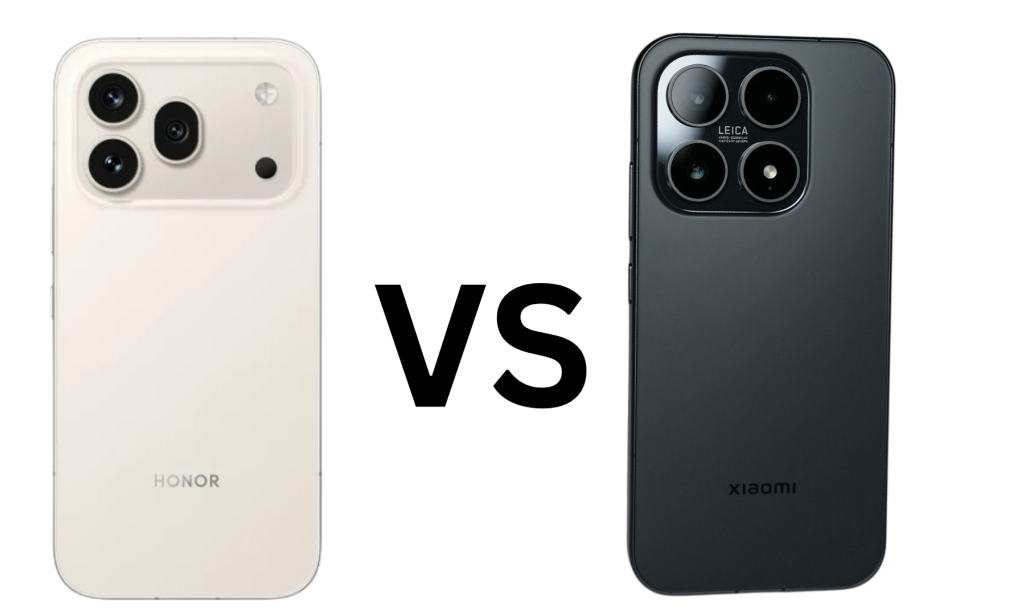
Both phones cost roughly the same. Both launched in 2026. Both run Android 16, use flagship-class hardware, and take mobile photography seriously. But the Honor 600 Pro and the Xiaomi 17 approach the idea of a premium smartphone from completely different directions, and choosing between them comes down to what kind of phone you actually want to live with every day.
Design and Build iPhone-Influenced vs Compact and Refined
The Honor 600 Pro is immediately recognizable. Its precision-carved unibody design, flat edges, and rectangular camera module bear an unmistakable resemblance to the iPhone 17 Pro an aesthetic choice that will appeal to some buyers and put others off. It measures 156 x 74.7 x 7.8mm, weighs 200 grams, and carries IP68, IP69, and IP69K triple water resistance certification. The narrowest display bezel on the device measures just 0.98mm, giving the front a genuinely edge-to-edge appearance.
The Xiaomi 17 takes a very different approach. At 151.1 x 71.8 x 8.1mm and 191 grams, it is a compact flagship shorter, narrower, and lighter than most phones in its class. The 6.3-inch body is genuinely one-hand-friendly in a way that the Honor 600 Pro is not. Both phones use glass fronts and aluminium frames with IP68 water resistance. The Xiaomi 17 uses Gorilla Glass Victus 2, while the Honor 600 Pro uses Mohs level 4 glass across the front panel.
Display: Same Specs on Paper, Different Strengths in Practice
Both phones use a 6.57-inch AMOLED display on the Honor 600 Pro and a 6.3-inch LTPO AMOLED on the Xiaomi 17. Both run at 120Hz and support HDR10+. Both hit 8,000 nits peak brightness on the Honor and 3,500 nits on the Xiaomi — a significant brightness gap that gives the Honor 600 Pro a clear edge in direct sunlight scenarios.
The Honor 600 Pro resolves at 1264 x 2728 pixels at 458 PPI. The Xiaomi 17 resolves at 2656 x 1220 at 464 PPI — essentially identical sharpness in day-to-day use despite the size difference. The Honor display is simply larger, which makes it more practical for video consumption and multitasking. The Xiaomi 17's LTPO panel gives it an advantage in battery conservation, dynamically dropping to 1Hz when the screen content is static.
Processor: New vs Established Performance
The Honor 600 Pro runs on the Qualcomm Snapdragon 8 Elite, the 2025 flagship chip built on a 3nm TSMC process with two Oryon V2 Phoenix L cores at 4.47GHz and six Oryon V2 Phoenix M cores at 3.53GHz, paired with an Adreno 830 GPU. This is the same chipset that powered the Galaxy S25 series and OnePlus 13, and it remains an exceptionally capable processor in 2026. It is paired with 12GB or 16GB LPDDR5X RAM and up to 1TB UFS 4.0 storage.
The Xiaomi 17 uses the newer Snapdragon 8 Elite Gen 5, built on a 3nm TSMC process with Oryon V3 cores running at up to 4.6GHz and an Adreno 840 GPU. On benchmarks, the Gen 5 scores approximately 15-20% higher than the original Snapdragon 8 Elite across CPU and GPU tests. In real-world use, both phones feel fast and responsive for every everyday task. The Xiaomi 17 has the edge in sustained gaming performance and future-proofing, but most users will not feel the difference in day-to-day use. The Xiaomi 17 is paired with 12GB or 16GB LPDDR5X RAM and up to 1TB UFS 4.1 storage.
Camera System — 200MP Statement vs Leica Precision
This is where the two phones have the most fundamentally different philosophies.
The Honor 600 Pro leads with a 200MP main camera using a 1/1.4-inch sensor, f/1.9 aperture, OIS, and PDAF. The 200MP count is the headline, but the practical benefit is the sensor size at 1/1.4-inch, it captures significantly more light than most competitors. Alongside it sits a 50MP periscope telephoto with 3.5x optical zoom and OIS, and a 12MP ultrawide with a 112-degree field of view and autofocus. The front camera is a 50MP portrait selfie shooter with f/2.0 and OIS. AI Super Zoom 2.0 extends the telephoto digitally using cloud-based algorithms, and the 200MP Ultra-Clear AI Portrait mode is designed specifically for detailed facial photography.
The Xiaomi 17 uses a triple Leica-tuned camera system built around a 50MP Light Fusion 950 main sensor with a 1/1.57-inch size, f/1.67 Leica Summilux optical lens, and OIS. The Leica partnership means Xiaomi's tuning prioritizes color accuracy, natural contrast, and the optical quality of the glass over megapixel counts. The secondary camera is a 50MP telephoto with 3x optical zoom, and the third is a 50MP ultrawide at 15mm equivalent focal length. The front camera is a 32MP shooter.
In practical terms, the Honor 600 Pro's 200MP main sensor captures more raw image data and gives the AI more to work with in low light and portrait scenarios. The Xiaomi 17's Leica optics deliver more consistent color science and natural rendition in standard conditions. The Honor wins in low light volume and telephoto versatility. The Xiaomi wins in color accuracy and optical quality. Neither is objectively better they are built for different photographic preferences.
Battery and Charging A Genuine Gap
The Xiaomi 17 carries a 6,330mAh silicon-carbon battery with 90W wired HyperCharge and 50W wireless charging, with 22.5W reverse wired charging supported. PhoneArena's battery life testing recorded an estimated 9 hours 48 minutes of screen-on time exceptional for a 6.3-inch compact flagship and one of the best battery results in its class.
The Honor 600 Pro uses a 7,000mAh battery with 80W wired charging, 50W wireless charging, and 27W reverse wired charging. The larger capacity gives it an endurance advantage on paper, and the 7,000mAh cell is one of the largest in any non-gaming smartphone at this size and weight. Charging speed is slightly slower at 80W versus Xiaomi's 90W, but the difference in charge time between the two is minor given the capacity difference.
Software: MagicOS 10 vs HyperOS 3
Both phones run Android 16. The Honor 600 Pro uses MagicOS 10 and promises six years of major Android OS updates. The Xiaomi 17 runs HyperOS 3 with five years of major OS updates promised.
MagicOS 10 is clean, fast, and has improved meaningfully over previous Honor software releases. HyperOS 3 is Xiaomi's most polished software to date, with a well-integrated AI layer, clean animations, and strong ecosystem integration with Xiaomi's own wearables and smart home products. Neither software is a disadvantage both are mature, feature-rich Android overlays that will serve buyers well for years.
Pricing and Who Each Phone Is For
The Honor 600 Pro starts at approximately $722 for the 12GB/256GB configuration. The Xiaomi 17 starts at approximately $650 for the equivalent 12GB/256GB variant, making it the more affordable of the two.
The Honor 600 Pro is the right choice for buyers who want the largest possible main camera sensor, a bigger and brighter display for media consumption, triple IP certification for maximum durability, and the longer 7,000mAh battery in a premium-looking flagship body.
The Xiaomi 17 is the right choice for buyers who want a genuinely compact one-hand-friendly flagship, Leica color science and optical quality from the camera system, the newer Snapdragon 8 Elite Gen 5 chip with better GPU performance, and exceptional battery endurance in a smaller body. At $72 less, it also offers better value relative to its spec level.

You must be logged in to post a comment.