
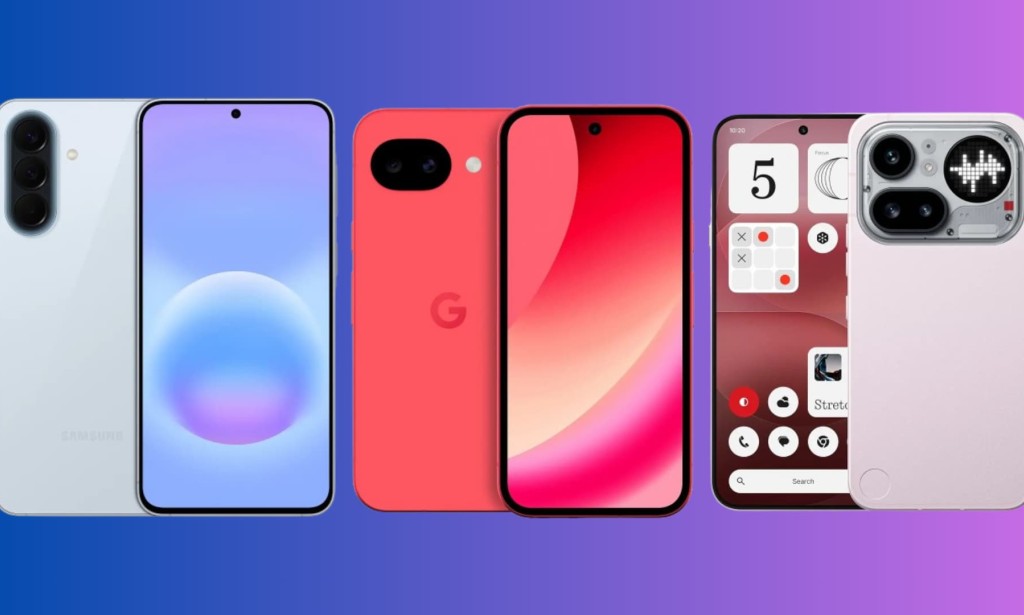
The $500 Android segment in 2026 is more competitive than it has been in years. Three phones in particular are fighting for the same buyers: Samsung's Galaxy A57, Google's Pixel 10a, and Nothing's Phone 4a Pro. Each takes a noticeably different approach to the mid-range formula, and understanding those differences is what will ultimately tell you which one actually suits your needs.
This comparison covers every area that matters design, display, chipset, camera, battery, software, and value using confirmed specs and verified information only. No hype, no exaggeration, no conclusions drawn before the evidence.
Price: Who Charges What
Starting price matters in this segment because a $50 difference is meaningful when the total is around $500.
The Samsung Galaxy A57 starts at $549.99 for the 8GB/128GB configuration and $609.99 for the 8GB/256GB. It launched on April 9, 2026, in the US.
The Google Pixel 10a starts at $499 for 8GB/128GB. It was launched on 18 February 2026.
The Nothing Phone 4a Pro starts at $499 for 8GB/128GB and $599 for 12GB/256GB. It was launched on 05 March 2026.
Samsung is the most expensive of the three. Both Google and Nothing come in $50 cheaper at the base configuration, though Samsung's base storage of 128GB matches the other two.
Design and Build Quality
This is one area where the three phones take genuinely different directions.
The Galaxy A57 is the slimmest of the three at 6.9mm thick and 179 grams. It has a glass back protected by Gorilla Glass Victus+, an aluminum frame, and a design language that closely echoes Samsung's flagship Galaxy S series. The build feels premium for the price point, and the overall aesthetic is clean and restrained. The edges are on the sharper side, which some users find uncomfortable during extended holds.
The Pixel 10a is thicker at 10.2mm and slightly heavier at 184 grams. Its back is plastic rather than glass, with an aluminum frame. The design is compact and functional Google prioritizes a smaller footprint over visual drama. Gorilla Glass 7i protects the front display.
The Nothing Phone 4a Pro is the heaviest of the three at 210 grams and measures 7.9mm thick. It uses an aluminum rear panel and aluminum frame, and an all-metal build that feels noticeably solid in hand. The Glyph lighting system on the back is Nothing's signature design feature. IP65 dust and water resistance is included.
On water resistance, the A57 carries an IP67 rating, the Pixel 10a offers an IP68 rating, and the Nothing Phone 4a Pro is rated IP65. The Pixel 10a technically offers the strongest water protection here, rated for immersion up to 1.5 meters for 30 minutes.
Display
The display is where preferences will become most evident.
The Galaxy A57 has a 6.7-inch Super AMOLED Plus panel with FHD+ resolution (2340x1080), 120Hz refresh rate, and a peak brightness of 1,900 nits. The screen-to-body ratio is 87.64%, and Gorilla Glass Victus+ covers the front. Vision Booster improves outdoor readability. It's one of the largest screens available in this price range.
The Pixel 10a has a 6.3-inch P-OLED panel with FHD+ resolution (2424x1080) and 120Hz refresh rate. The pixel density is 421 PPI meaningfully higher than the A57's 385 PPI which makes text and fine detail slightly sharper. Peak brightness reaches 3,000 nits, which is significantly higher than both the A57 and the Nothing Phone 4a Pro. The screen-to-body ratio is 79.39%, which is noticeably lower than the A57.
The Nothing Phone 4a Pro has a 6.8-inch AMOLED display with a 2800x1260 resolution, making it the sharpest panel of the three. The 120Hz refresh rate is standard across all three. Nothing's display is slightly larger than the A57 while offering higher resolution.
If sheer screen size matters to you, the Nothing Phone 4a Pro edges out the A57. If pixel sharpness is the priority, the Pixel 10a and the Nothing Phone 4a Pro both outresolve the A57. If brightness in outdoor conditions is the deciding factor, the Pixel 10a wins clearly.
Chipset and Performance
All three phones use 4nm chips, but they come from three different manufacturers.
The Galaxy A57 runs on Samsung's Exynos 1680, a tri-cluster octa-core chip with a top core clocked at 2.9GHz. Samsung upgraded the NPU specifically to support the Awesome Intelligence AI features built into One UI. Day-to-day performance is reported as smooth and responsive, though the Exynos 1680 is not positioned as a gaming chip. Samsung also included a 13% larger vapor chamber compared to the A56 to help manage sustained workloads.
The Pixel 10a runs on Google's Tensor G4, the same chip found in the Pixel 9 series. Its top core reaches 3.1GHz. The Tensor G4 is designed around Google's on-device AI and machine learning capabilities rather than raw CPU throughput. Gaming GPU performance on the Tensor G4 is notably stronger than what the Exynos 1680 delivers, according to independent testing.
The Nothing Phone 4a Pro uses Qualcomm's Snapdragon 7 Gen 4. This is an entirely different class of chipset architecture from both Samsung's Exynos and Google's Tensor. The Snapdragon 7 Gen 4 has a strong track record for consistent performance across demanding applications and is generally considered the most reliable of the three for sustained gaming and GPU-heavy tasks.
For everyday tasks, social media, streaming, calls, and browsing are all more than sufficient. For gaming and GPU workloads, the Nothing Phone 4a Pro and Pixel 10a have an advantage over the A57.
Camera System
Camera setups differ notably across the three devices.
The Galaxy A57 has a triple rear camera: 50MP main sensor with OIS, 13MP ultrawide, and 5MP macro lens. The front camera is 12MP. Nightography support, improved ISP processing, Auto Trim for video editing, and Samsung's consistent post-processing pipeline are all included. The main camera is strong and reliable for a mid-range device, though the macro lens is limited in utility compared to a telephoto.
The Pixel 10a has a dual rear camera: 48MP main with OIS and a 13MP ultrawide. No macro or telephoto is included. What the Pixel 10a offers instead is Google's computational photography engine HDR+, Night Sight, Real Tone, and Magic Eraser which consistently produce results that punch above the hardware's resolution. Google's camera processing is widely regarded as the best in this price bracket.
The Nothing Phone 4a Pro has a triple rear camera with a 50MP main, 50MP telephoto with 2x optical zoom, and an 8MP ultrawide. The inclusion of a proper telephoto lens is a meaningful differentiator neither the A57 nor the Pixel 10a offers optical zoom at this price. The 50MP ultrawide is also significantly better than what the A57 provides.
For versatility across different shooting scenarios including zoom, the Nothing Phone 4a Pro's camera setup is the most complete on paper. For computational photography quality and processing consistency, the Pixel 10a remains the benchmark. The A57 offers reliability and a solid main camera but trails both competitors on ultrawide and zoom.
Battery and Charging
Battery specs are close across the three devices, but charging tells a more differentiated story.
The Galaxy A57 has a 5,000mAh battery and supports 45W wired charging the fastest of the three. It does not support wireless charging.
The Pixel 10a has a slightly larger 5,100mAh battery and supports 30W wired charging alongside 10W wireless charging. Real-world battery life testing has given the Pixel 10a a longer endurance score despite the modest charging speed advantage the A57 holds.
The Nothing Phone 4a Pro has a 5,080mAh battery and supports fast wired charging. Wireless charging support is also included.
If speed of charging is the deciding factor, the A57 wins. If wireless charging matters to you, the Pixel 10a and Nothing Phone 4a Pro both offer it while the A57 does not have a notable omission at this price in 2026.
Software and Long-Term Support
Software longevity has become a major selling point in the mid-range segment, and all three manufacturers are now competing directly on update commitments.
The Pixel 10a ships with Android 16 and Google's stock Android experience. Google promises seven years of OS and security updates currently the longest update commitment from any Android manufacturer.
The Nothing Phone 4a Pro ships with Android 16 and Nothing OS. Nothing has been committed to three years of OS updates and four years of security patches the shortest update commitment of the three.
For users who keep their phones for four or more years and care about staying on the current OS version, the Pixel 10a has the strongest guarantee. Samsung's six-year commitment is competitive. Nothing's three-year window is comparatively limited.
Who Should Buy Which
The Galaxy A57 makes the most sense for someone already invested in Samsung's ecosystem, who values a large display, slim design, fast 45W charging, and a consistent Samsung software experience. The six-year update commitment and reliable camera make it a safe long-term choice.
The Google Pixel 10a makes the most sense for someone who wants the best camera processing in this price bracket, seven years of guaranteed updates, wireless charging, and a compact form factor. It costs $50 less than the A57 and offers stronger GPU performance.
The Nothing Phone 4a Pro makes the most sense for someone who wants design differentiation, the most versatile camera setup of the three including optical zoom, solid performance from the Snapdragon 7 Gen 4, and a phone that stands out from the crowd. It comes in $50 cheaper than the A57 but has a shorter software update commitment.

You must be logged in to post a comment.