
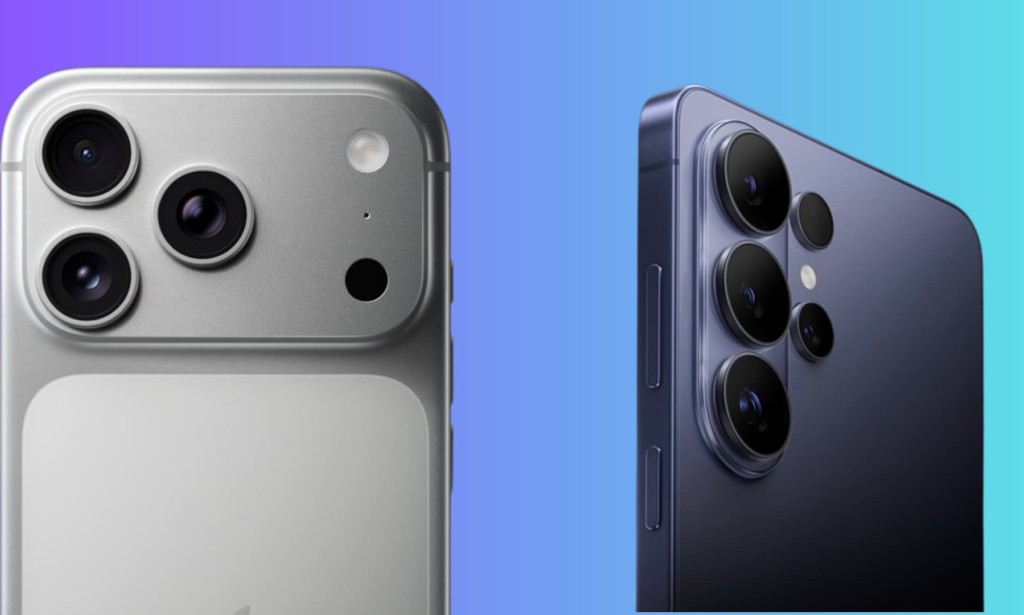
This is the comparison that comes up every year without fail, and every year the answer is more complicated than either side wants to admit. The Samsung Galaxy S26 Ultra and the iPhone 17 Pro Max are the two best camera phones you can buy right now. They are priced similarly, both pack multiple rear cameras, both have been tested exhaustively by independent reviewers and neither one wins cleanly across every category.
Here is what the camera systems actually look like, how they perform in real shooting conditions, and which one deserves your money if photography is the priority.
The Camera Systems Side by Side
The Galaxy S26 Ultra uses a quad camera system. The main camera is a 200MP Samsung ISOCELL HP2 sensor with a 1/1.3-inch sensor size, f/1.4 aperture, 23mm equivalent focal length, and OIS with PDAF. The secondary camera is a 50MP ultrawide with a 1/2.5-inch sensor, f/1.9 aperture, and PDAF autofocus. The third is a 10MP 3x optical zoom telephoto using a Sony IMX754 sensor with a 1/3.94-inch size, f/2.4 aperture, and OIS. The fourth is a 50MP 5x periscope telephoto with OIS, covering longer distance shots. The front camera is a 12MP shooter with a wider lens than the Galaxy S25 Ultra, which Samsung updated specifically to capture more of the scene in selfies.
The iPhone 17 Pro Max uses a triple camera system. The main camera is 48MP with a 1/1.28-inch sensor, f/1.8 aperture, 24mm equivalent focal length, and sensor-shift OIS. The ultrawide is 48MP with an f/2.2 aperture, 13mm equivalent focal length, and sensor-shift OIS. The telephoto is a 48MP periscope lens with 4x optical zoom, an f/2.8 aperture, and OIS. The front camera is 18MP higher resolution than the S26 Ultra's selfie shooter and introduces a multi-aspect sensor that captures landscape-oriented photos even when holding the phone vertically.
Main Camera: Two Different Approaches to the Same Problem
The 200MP versus 48MP comparison is one of the most misleading numbers in smartphone photography right now. Neither phone shoots every photo at its maximum resolution. The S26 Ultra's 200MP sensor uses pixel binning to produce 12.5MP or 50MP output depending on shooting conditions, combining multiple pixels into one for better light capture and noise reduction. The iPhone 17 Pro Max's 48MP sensor uses a 24MP default with ProRAW and ProRes options for full resolution.
What actually matters is sensor size and aperture. The S26 Ultra's 1/1.3-inch main sensor with an f/1.4 aperture lets in significantly more light per frame than the iPhone's 1/1.28-inch sensor at f/1.8. That wider aperture is the reason the S26 Ultra tends to pull ahead in low-light photography, where the ability to gather more light in less time translates directly to cleaner, brighter images with less noise.
In daylight, the results from both phones are excellent and the gap is narrow. Samsung's processing tends toward slightly more vivid colors and stronger contrast. Apple's processing prioritizes natural, accurate color reproduction and more restrained sharpening. Whether the Samsung or iPhone result looks better is genuinely a matter of personal preference, and independent shooters who have tested both phones extensively consistently call daylight photography a draw.
In low light, the S26 Ultra's f/1.4 aperture gives it a measurable advantage. Photos taken in dim indoor environments and at night show more detail, more natural exposure, and less noise on the S26 Ultra in consistent side-by-side testing. Apple has improved its Night Mode significantly over the past two generations, but the physics of aperture size still favor Samsung's wider lens in genuinely challenging light.
Ultrawide: iPhone Pulls Ahead Here
Both ultrawide cameras are 48MP or 50MP, but the iPhone 17 Pro Max's ultrawide is the stronger performer in this category. It uses sensor-shift OIS optical image stabilization on a wide-angle lens which is unusual and delivers noticeably sharper handheld ultrawide shots, particularly in low light. The S26 Ultra's ultrawide uses PDAF autofocus for close-up shots, which is a meaningful practical advantage for macro photography at wide angle. But for pure image quality across a range of lighting conditions, iPhone's ultrawide system is the more consistent performer.
Telephoto: Where It Gets Complicated
The S26 Ultra has two telephoto cameras: a 3x lens for mid-range zoom and a 5x periscope for longer distances. The iPhone 17 Pro Max has a single 4x periscope telephoto. In theory, having a 3x option as a bridge should give the S26 Ultra an advantage at the mid-range zoom distances between 1x and 5x. In practice, the 3x lens on the S26 Ultra uses a smaller sensor than the 5x, and at its native 3x zoom distance the image quality is not significantly better than what the main camera can produce through cropping. Independent reviewers including GSMArena have noted that the 3x lens adds less incremental quality than the hardware spec suggests it should.
The iPhone 17 Pro Max's 4x periscope telephoto is a significant upgrade over its predecessor and delivers very strong results at its native zoom distance. At 5x, the S26 Ultra's periscope produces comparable quality to the iPhone at 4x, and both phones use AI upscaling beyond their optical zoom limits. At extreme zoom distances 10x and beyond the S26 Ultra's Space Zoom technology pushes further with more usable results, though quality degrades on both phones at these distances.
For most real-world telephoto use portraits, events, and wildlife at a moderate distance the two phones are very closely matched. The S26 Ultra has more zoom range. The iPhone 17 Pro Max delivers cleaner optical quality within its zoom range.
Video: iPhone Maintains Its Edge
Video is the one area where Apple's advantage over Samsung is most consistent and most difficult to argue away. iPhone 17 Pro Max records ProRes 4K video internally, supports Log format for professional color grading, and delivers more natural motion and better dynamic range in difficult lighting across the board. Samsung has improved its video processing considerably with the Galaxy S26 Ultra and video quality is genuinely strong, but professional videographers and independent reviewers consistently favor the iPhone for cinematic footage.
For casual video family moments, travel content, and social media clips both phones produce excellent results that the vast majority of viewers would not be able to distinguish in a blind test.
Selfie Camera: Advantage iPhone
The iPhone 17 Pro Max's 18MP front camera with multi-aspect sensor capability is the more capable selfie shooter. The multi-aspect feature which captures landscape-framed selfies while holding the phone vertically is a genuinely useful addition for group shots and travel photography. The Galaxy S26 Ultra widened its 12MP front camera lens this generation, which captures more of the scene, but the resolution and dynamic range of the iPhone selfie camera are higher.
Which One Should You Choose for Photography
The Samsung Galaxy S26 Ultra is the better choice for low-light photography, long-distance zoom, and buyers who want the widest range of shooting options in a single device. The 200MP main sensor, f/1.4 aperture, and Space Zoom give it measurable hardware advantages in specific scenarios.
The iPhone 17 Pro Max is the better choice for video, ultrawide photography, selfies, and buyers who value natural color accuracy over Samsung's more processed look. ProRes video recording and the multi-aspect front camera are features that have no direct equivalent on the S26 Ultra.
For everyday shooting across a range of situations, both cameras are exceptional and either choice is defensible. The platform you prefer Android or iOS is ultimately a more practical factor than the camera system when deciding between these two phones.

You must be logged in to post a comment.